
Noble Fates vs Going Medieval: Which to Play
Noble Fates versus Going Medieval compared: fantasy politics and mages versus grounded medieval construction, plus which colony sim fits your playstyle.
Pick Noble Fates if you want a fantasy kingdom with politics, religion, magic and a ruler whose nobles can betray them. Pick Going Medieval if you want grounded medieval survival and deep multi-storey construction without fantasy elements. They are bundled together because they overlap, not because they are the same game.
The two games get compared constantly, and the comparison is fair: both are 3D colony sims where individual settlers have needs, skills and opinions. The difference is what the simulation is about.
The one-paragraph version
Noble Fates simulates a court. Your nobles have ambitions, memories and beliefs, and the drama comes from loyalty, succession and divine favour. Going Medieval simulates a settlement: a band of survivors building a home in a hostile medieval world, with construction depth as its core pleasure.
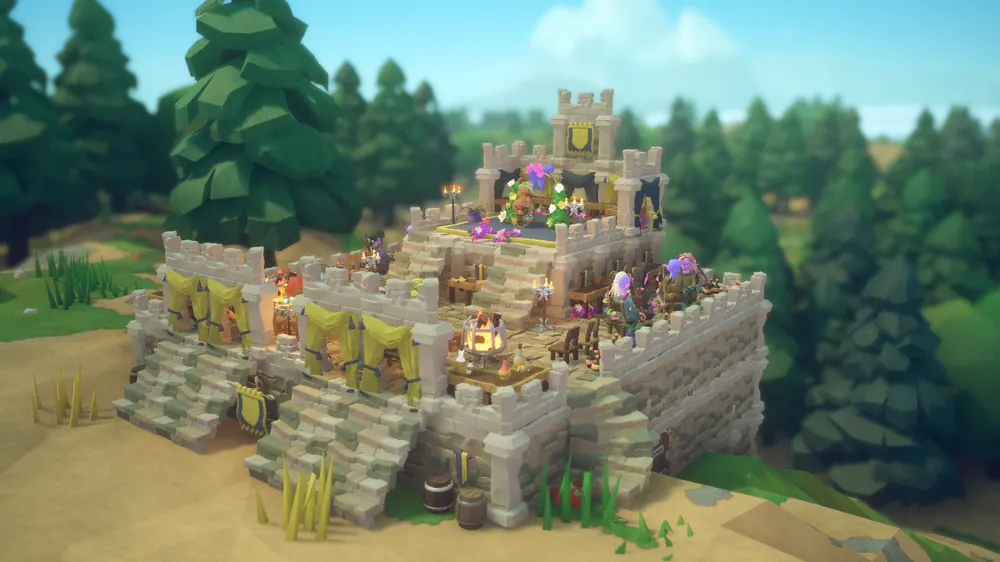
Side by side
| Dimension | Noble Fates | Going Medieval |
|---|---|---|
| Setting | High fantasy, five races, gods and demons | Historical medieval, humans only |
| Core fantasy | Rule a kingdom, manage a court | Survive and build a settlement |
| Characters | Nobles with opinions, memories, ambition | Settlers with needs and skills |
| Politics | Principles, alignment, diplomacy, succession | Faction relations and raids |
| Magic | Mages, spells, breaches, a demon dragon | None |
| Religion | Altars, shrines, idols, favor, gods | None in the same sense |
| Construction | Props, rooms, quality, prestige, terraforming | Deep multi-storey building and room quality |
| Combat | Melee, ranged, magic, patrols, gate houses | Melee, ranged, raids, defences |
| Signature system | Succession and noble loyalty | Vertical construction and settlement design |
Where Noble Fates wins
1. Characters you remember
A noble in Noble Fates can resent you, leave, found a rival kingdom or betray you in a fight. That is a story engine. In Going Medieval, settlers have personalities, but the drama is more about surviving the winter than about who deserves the throne.
2. Politics as a system
Principles, alignment, surrendered rulers, installed governors, marriage alliances. Noble Fates lets you play a diplomat, a tyrant or a holy order. The principles guide→ shows how far the stance system reaches.
3. Fantasy spectacle
Mages, Magic Missiles, breaches, Lesser Imps climbing walls and a Demon Dragon that attacks from the sky. Going Medieval deliberately has none of this. If you want fantasy, there is no contest.
4. Dynasty play
Succession, heirs, bestowal and Ages give a campaign a multi-generational arc. Your first ruler's mistakes become your heir's problem.
Where Going Medieval wins
1. Construction depth
Going Medieval's building system is the reason many players prefer it. Multi-storey structures, room quality, temperature and structural logic are the heart of the game. Noble Fates has a strong building system with props, quality and prestige, but its identity is the court, not the castle.
2. A tighter survival loop
Going Medieval is more focused on the classic colony-sim loop: feed everyone, keep them warm, build better rooms, survive the raid. That focus makes it easier to learn.
3. Historical grounding
No magic means no balance weirdness. The rules are about people, food, temperature and steel.
Where they overlap
- Both have individual settlers with needs, skills and moods.
- Both have raids and defensive building.
- Both reward careful room design and storage management.
- Both are sold together in a bundle, and the bundle is genuinely good value if you like the genre.
Which should you play first?
Play Noble Fates first if:
- you want a story with a ruler and a court,
- fantasy races and magic appeal to you,
- you like politics, succession and morally loaded choices,
- you are comfortable with a game that is rough around the edges but ambitious.
Play Going Medieval first if:
- you want a grounded construction game,
- you prefer a focused survival loop over political drama,
- you do not want magic or fantasy races,
- you want the more conventional colony-sim onboarding.
Play both if: you like the genre. They scratch different itches, and the bundle exists for a reason.
What about performance and mods?
Noble Fates has a strong Workshop scene, including UI, performance and kingdom-size mods. The mods guide→ covers the essentials. Going Medieval also has a Workshop, focused more on building pieces and quality-of-life.
If late-game lag worries you, both games benefit from performance mods and from not overbuilding. Noble Fates in particular has Stig's Performance specifically for the 10x speed lag.
The honest caveats
Noble Fates launched 1.0 recently and is still receiving hotfixes. Expect the occasional crash fix patch, and read the patch notes before a long session. Going Medieval is the more settled product in terms of scope, though both games keep updating.
Neither game is a pure power fantasy. Both will kill your settlers if you ignore food, warmth and defence.
Sources
Official source: Noble Fates on Steam ↗
- Noble Fates store page ↗ for the fantasy kingdom feature set and the bundle.
- 1.0 patch notes ↗ for the current state of the game.
- Steam Workshop ↗ for the mod scene.

FAQ
Is Noble Fates a Going Medieval clone?
No. They share a genre and a bundle, but Noble Fates is built around court politics, fantasy races, worship and magic, while Going Medieval is a grounded medieval settlement builder.
Does Noble Fates have multi-storey building?
Yes, it has vertical construction and roof props, though Going Medieval's construction system is more central to its design.
Which is harder?
Neither is clearly harder. Noble Fates punishes political mistakes as much as survival mistakes; Going Medieval punishes a bad harvest or a cold snap.
Are they in a bundle?
Yes. Noble Fates is bundled with Going Medieval, along with Caves of Qud, Space Haven, Diplomacy is Not an Option and Dungeon Settlers in various bundle configurations.