
Noble Fates Food Guide: Storage, Decay, Cooking
Stop food decay in Noble Fates: larder layout, cooking throughput, storage specializations, eating permissions and a winter food buffer that holds.
Food fails for three reasons: it is stored outdoors, it is stored raw, or nobody is assigned to cook. Build an enclosed larder next to the kitchen, set storage specializations, cook in batches before meals, and keep a buffer of preserved food for winter.
A kingdom with a farm and no larder is a kingdom that harvests a field and eats half of it after it rots. The food system in Noble Fates has more moving parts than the early game suggests.
The four stages of food
Think of food as a pipeline with four stages, each with a failure mode.
| Stage | Failure | Fix |
|---|---|---|
| Production | Not enough crops or meat | More fields, pastures, foraging |
| Storage | Decay before use | Enclosed larder, shelves, cool placement |
| Preparation | Raw food, low mood | Assigned cook, cooking station |
| Allocation | Wrong people eating the wrong food | Eating permissions, storage specializations |
Fix the pipeline in order. Cooking more food does not help if the larder is a hole in the ground.
Stage 1: production
Sources, roughly in order of reliability:
- Farms. Fields of crops, watered and harvested. See the farming guide→.
- Foraging. Berries and forageables early, less reliable in winter.
- Fishing. Reachable water and a forager willing to walk to it.
- Animals. Milk, meat and eggs from pastures. See animal breeding→.
- Hunting. Meat from wildlife, useful but inconsistent.
- Trade. Buying food is a legitimate strategy for a rich, small kingdom.
Do not rely on a single source. A farm plus a pasture plus foraging gives you three independent failure points instead of one.
Stage 2: storage and decay
Food decays. The rate depends on where it is stored.
Rules that hold:
- Indoors beats outdoors. An enclosed room with a roof slows decay.
- Shelves beat floor. Stacked storage holds more in less space and keeps items organized.
- Cool and dry beats hot and wet. Keep the larder away from forges and kitchens' heat sources.
- Raw food is more perishable than prepared food. Cook what you can.
Build a dedicated larder:
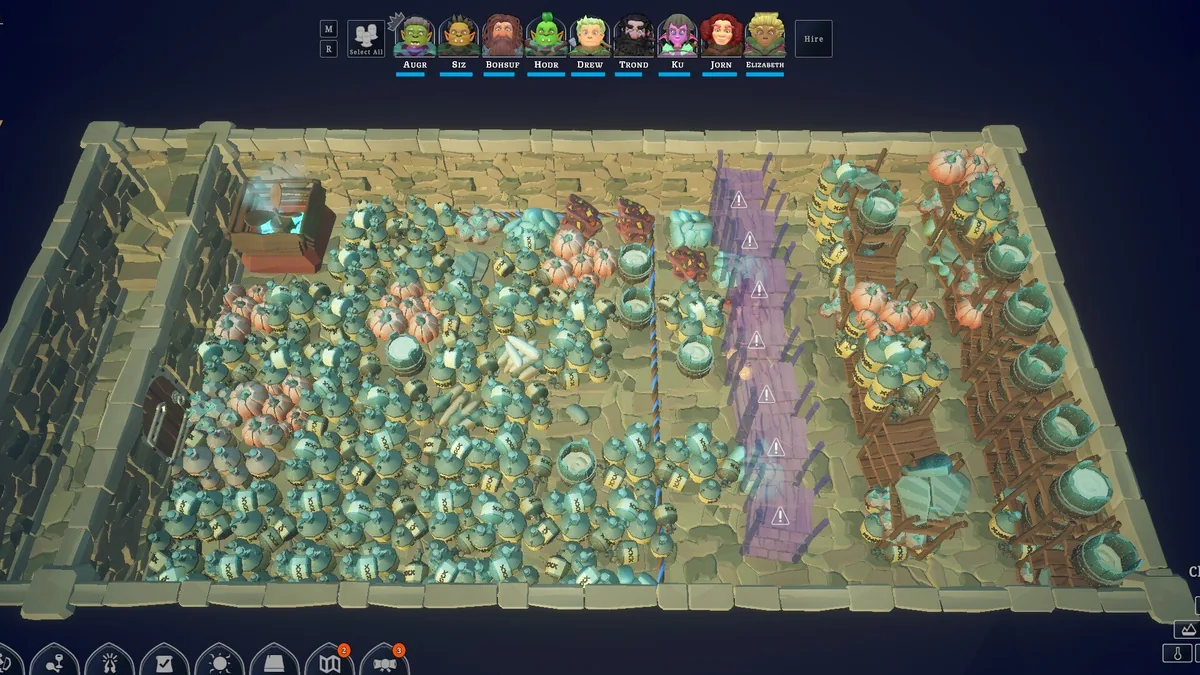
- A room of 4x4 or larger, enclosed and roofed.
- A door, positioned so haulers do not walk through the kitchen.
- Shelves along the walls, floor clear in the middle.
- Storage specializations set per pile.
Storage specializations
In 1.0, storage can be set to Salvage, For Sale, Junk or None, and the specialization overrides normal priority. That matters for food:
- A For Sale pile holds surplus you intend to sell.
- Junk holds spoiled or unwanted items.
- None means the pile accepts nothing.
Do not let cooked meals sit in a Salvage pile where a hauler will break them down. Set the food pile explicitly.
Stage 3: cooking
Cooking turns raw food into meals. Meals are better for mood and usually better for preservation.
Practical setup:
- One cooking station, enclosed, with ingredient storage within a few tiles.
- One assigned cook with cooking as their top job priority.
- Cooking scheduled before meal blocks, so food is ready when the court eats.
- A second cook once the court passes roughly a dozen nobles.
A cook who also farms is not a cook. They are a farmer who occasionally burns something.

Stage 4: allocation and eating permissions
1.0 reworked eating permissions, and old permissions do not migrate. If you are loading an old save, check them.
What to set:
- Nobles eat meals first.
- Serfs eat staples and surplus.
- Prisoners eat the cheapest acceptable food. Do not let them eat your good meals.
- Animals eat feed, not your larder.
If nobles are eating raw crops while meals sit in storage, the permissions or the storage rules are wrong.
The winter buffer
Winter is the test. Crops go dormant, foraging drops, and animals produce less.
Targets for a stable kingdom:
- Enough preserved or stored food for the full dormant period, plus a margin.
- A cold-weather crop plan, or an underground farm.
- Livestock that can be slaughtered if the buffer runs short.
- A trade reserve of coin to buy food in an emergency.
Do not measure the buffer in "days of food" alone. Measure it in meals for the number of mouths you expect to have, because babies and recruits both eat.
Underground farms
Underground farming is the strongest winter answer, but it has requirements:
- Light, from lamps or windows.
- Water, from a pump and outlet or irrigation.
- Soil or growing props, depending on the crop.
An underground farm is a mid-game project. Start it before your first hard winter, not during it.
Food and mood
Food is not just calories. Meal quality and variety feed mood, and mood feeds loyalty.
- Cooked meals beat raw ingredients.
- A dining room beats eating in the field.
- Enough seats beat standing.
- A pleasant room beats a dark one.
The rooms guide→ covers the dining hall.
Common food mistakes
- Storing food outside. The single most common cause of famine in a rich kingdom.
- No dedicated cook. Everyone cooks, nobody cooks well.
- Raw food for nobles. Mood and health both suffer.
- No winter buffer. A good autumn hides a bad plan.
- Wrong storage specialization. Meals end up in the junk pile.
- Too many mouths, too few fields. Check the kingdom size guide→ before recruiting.
Sources
Official source: Noble Fates on Steam ↗
- 1.0 patch notes ↗ for food stacks, storage specializations and eating permissions.
- Steam store page ↗ for the "fill bellies" design framing.
- Steam Community guides ↗ for player food layouts.
FAQ
How do I stop food from decaying?
Store it indoors in an enclosed, roofed larder, on shelves, away from heat. Cook raw food into meals when you can.
Why are my nobles eating raw food?
Either there is no cooked meal available, the cooking job has no assigned cook, or eating permissions are set wrong.
Do I need a separate larder room?
You can store food in the kitchen, but a separate larder is better because it stays cooler and keeps the kitchen clear for cooking.
How much food should I stock for winter?
Enough meals for every mouth for the full dormant season plus a margin, with coin or trade goods as backup. Babies and new recruits increase the requirement.