
Noble Fates How to Get Iron: Prospecting and Smelting
Find and use iron in Noble Fates: why mining needs line of sight, how caves reveal ore, what to research first and how to turn ore into weapons.
Iron comes from mining ore you can see. Mining requires line of sight, so you dig along exposed rock and into caves rather than blind-tunnelling. Research mining and metalworking, assign a miner with a pick, and smelt ore before you can forge weapons. Terraforming can reshape iron later, but it is a mid-game tool.
Iron is the gate between a wooden kingdom and an armed one. Players who cannot find it usually have not dug far enough, or have not understood the line-of-sight rule.
The line-of-sight rule
In 1.0, mining requires line of sight. You cannot designate a tile deep inside a mountain with no exposed face and expect a miner to reach it.
What that means in practice:
- Dig in steps: expose a face, mine it, expose the next.
- Follow caves when you find them. Caves are natural tunnels that reveal ore and connect underground areas.
- Watch for the Cave Discovered notification. It is your cue that a new underground region is open.
Blind tunnelling still works mechanically in the sense that you can dig a tunnel, but you must dig it from an accessible face outward. Plan tunnels as spirals or staircases, not as isolated rooms.
Where iron actually is
Iron appears as ore in stone, usually underground and often near cave systems.
Practical prospecting:
- Look for exposed stone on the surface. Cliffs and hillsides are free faces.
- Dig inward from the surface in a straight line, then branch.
- Explore caves. Ore is visible in cave walls.
- Go deeper. Deeper layers hold better metals, including silver and gold, and magicite for portal shields.
- Check the map for mountain biomes. A flat map has less accessible stone.
If you have dug a long tunnel and found nothing, you are probably too shallow or too far from the mountain's core.
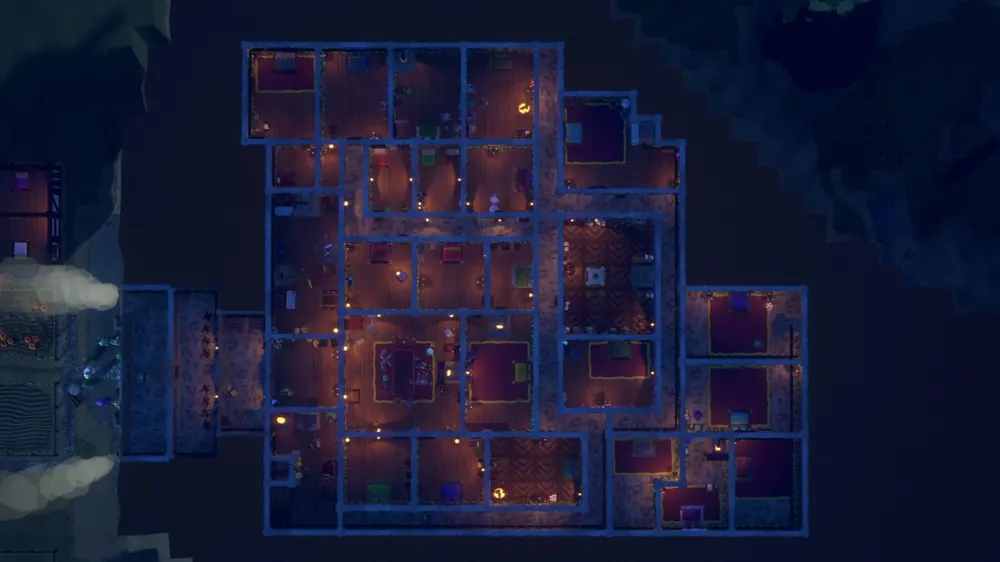
The mining workflow
- Assign a miner. Mining as a top-priority job. A noble with high Mining skill digs faster and finds more.
- Provide a pick. Mining needs the right tool.
- Mark the ore. Designate the ore tiles for mining.
- Haul the ore. Ore goes to a stockpile or directly to the smelter.
- Smelt. Ore becomes metal at a smelting station.
- Forge. Metal becomes weapons, armour, tools and building fittings.
Each step can bottleneck. A great miner with no smelter produces a pile of rocks, not an army.
Research order for iron
Research is what unlocks the metal chain. Prioritize:
- Mining improvements - faster digging, better reach.
- Smelting - turning ore into usable metal.
- Metalworking and forging - weapons, armour, tools.
- Better building pieces - metal fittings, reinforced doors, gate house parts.
Do not research magic before you can make an iron sword. The research guide→ covers the wider tree.
Iron and the gate house
Gate house pieces need Cranques, and the gate house is the single best defensive structure in the game. Iron feeds the chain that makes a gate house possible, which means the metal economy is also the defence economy.
If you are being raided before you have iron:
- Build wooden walls and a door.
- Use terrain as a wall.
- Research toward the gate house.
- Hire mercenaries, who do not count toward kingdom size.
Terraforming iron
Terraforming can reshape stone, copper, iron, silver and gold. That means you can, in the mid-game, sculpt the terrain to expose or create the resources you need.
It is not a fix for a bad early game. It is a tool for a designed fortress:
- Flatten a plateau for a gate house approach.
- Cut a channel for water.
- Expose a metal seam near your smelter.
Terraforming is slow and labour-hungry. Use it to optimize, not to rescue.
Mods that change iron
If you find the metal economy too slow, the Workshop has options:
- Mine More - increases ore yield.
- More Stone - more stone available.
- Patchwork - a bundle that includes Mine More, More Stone and other resource mods.
- Alchemy - adds transmutation, which can convert materials.
Mods change balance, so decide whether you want a faster game before installing them. The mods guide→ compares the options.
Common iron mistakes
- Blind tunnelling. Mining needs line of sight; dig from faces.
- No smelter. Ore is not metal.
- No miner assigned. Mining as a low-priority job means nobody digs.
- Ignoring caves. Caves are free tunnels and free ore.
- Stopping at the first seam. Deeper is better.
- Skipping the gate house. Iron without fortification is just heavier bodies.
Sources
Official source: Noble Fates on Steam ↗
- 1.0 patch notes ↗ for mining line of sight, cave discovery, terraforming and gate house materials.
- Steam store page ↗ for the kingdom-building framing.
- Steam Workshop ↗ for resource mods.

FAQ
Why can't my miner reach the ore?
Mining requires line of sight. Dig a tunnel from an accessible face toward the ore instead of designating an isolated tile.
Where do I find iron ore?
In stone, usually underground and often in cave walls. Deeper layers hold more, along with silver, gold and magicite.
Do I need a smelter to use iron?
Yes. Ore must be smelted before it can be forged into weapons, armour and tools.
Can I create iron with terraforming?
Terraforming can reshape iron along with stone, copper, silver and gold, but it is a slow mid-game tool, not an early fix.