
Noble Fates Kingdom Size: How Big Can You Build
Noble Fates kingdom size tiers, the Esteem preference system, what counts toward your population, and how to grow past the Large tier with mods.
Kingdom size is a belief tier, not an arbitrary build limit: Tiny up to 4 mortals, Small up to 8, Medium up to 12, Large up to 16. Each noble has a size preference, and a kingdom that outgrows it costs Esteem. To go past Large you either accept the Esteem hit or install a kingdom-size mod.
Players ask "how big can my kingdom get" expecting a number like a map limit. The real answer is a social one. Your kingdom has a declared size, your nobles have opinions about that size, and the gap between the two is a mood penalty.
The size tiers
The documented tier table:
| Size | Mortals |
|---|---|
| Tiny | up to 4 |
| Small | up to 8 |
| Medium | up to 12 |
| Large | up to 16 |
In 1.0, prisoners and mercenaries no longer count toward kingdom size. Babies do count. That matters more than it sounds: a growing family can push you over a tier without you recruiting anyone.
Why size is a belief, not a cap
Every noble has a kingdom size preference. Some want a small, intimate court. Some want a sprawling kingdom. Esteem tracks whether the kingdom matches their preference.
Consequences:
- A noble who prefers Small in a Large kingdom loses Esteem over time.
- A noble who prefers Large in a Tiny kingdom is also unhappy, because the kingdom is too small for their ambition.
- Esteem feeds mood, and mood feeds loyalty, work speed and the risk of defection.
This is why you cannot simply recruit until the map is full. At some point you are trading labour for loyalty.
What actually counts
| Category | Counts toward size? |
|---|---|
| Ruler | Yes |
| Nobles | Yes |
| Serfs | Yes |
| Babies and children | Yes |
| Prisoners | No, since 1.0 |
| Mercenaries | No, since 1.0 |
Practical effect: mercenaries became a much better deal in 1.0. You can hire muscle for a war without inflating your kingdom size or upsetting small-kingdom nobles. Prisoners are likewise a free labour and ransom pool.

Growing from Tiny to Large without wrecking Esteem
The clean path is to grow in steps and check opinions between each step.
- Tiny to Small (4 to 8). Recruit for necessity, not curiosity. One cook, one builder, one farmer, one guard.
- Small to Medium (8 to 12). Add specialists: a miner, a crafter, a researcher. Start the worship wing here so Esteem has a positive counterweight.
- Medium to Large (12 to 16). Add a second guard shift and a dedicated hauler. This is where housing quality and food throughput decide whether the kingdom holds together.
Between steps, open the nobles panel and look for Esteem warnings. If two or more nobles are unhappy about size, pause recruitment and improve rooms, food and worship first.
The more people guide→ covers recruitment sources.
Going past Large
Vanilla stops at Large. If you want a 30 or 100 mortal kingdom, you need a mod.
The main option is Very Large Kingdom Size (Workshop ID 3448066786). It adds a chain of Very Large Kingdom beliefs that raise the ceiling, up to 100 mortals in the current version. The mod's own notes explain the tier logic: at 29 mortals you need the second Very Large belief, and babies count toward the total. The author also notes that mercenaries and prisoners are excluded by the base game.
What to expect with a modded large kingdom:
- Performance pressure. More mortals means more pathfinding and more AI. Stig's Performance mod exists specifically for late-game lag at high speed.
- Food and housing scale faster than you think. A 30-mortal kingdom needs multiple kitchens, a real larder and a housing block, not a bigger version of the starting camp.
- Esteem management becomes a full-time job. More nobles means more preferences to satisfy.
The mods guide→ compares the performance and UI mods that make large kingdoms playable.
Is a small kingdom better?
For a first campaign, yes. Small kingdoms are easier to feed, easier to defend and easier to read. You see every noble's mood, every job and every bottleneck.
Small also has strategic advantages:
- Fewer mouths means fewer food crises in winter.
- A compact wall perimeter is cheaper and stronger.
- Raids scale with your strength and wealth, so a small rich kingdom can be a harder target than a large poor one.
The ideal is not "as big as possible". It is "as big as your food, housing and Esteem can support".
Kingdom size and difficulty
Difficulty interacts with size in ways that are easy to miss:
- Multiple wars raise both the frequency and the difficulty of attacks.
- Raids can include tamed animals, and demons breach in waves.
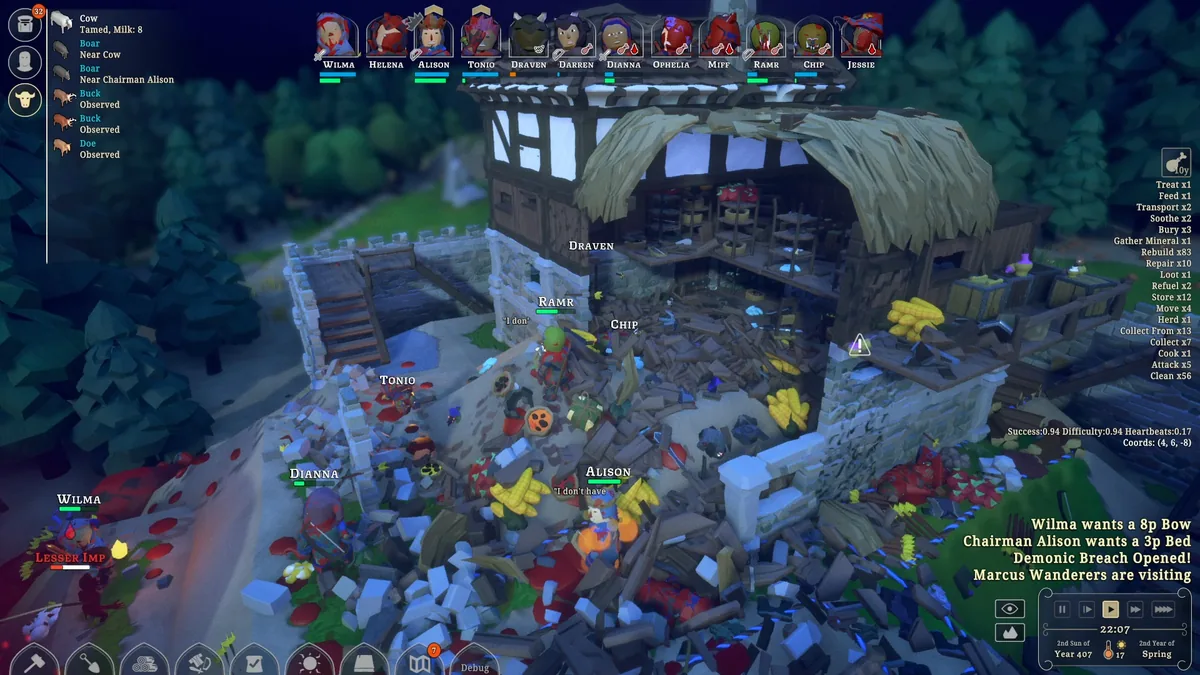
- A large kingdom presents more targets, and a single breach can cascade.
If you grow fast, grow behind walls. Gate houses with portcullises and daily patrols are the difference between a raid being an event and a raid being the end.
Sources
Official source: Noble Fates on Steam ↗
- Noble Fates Wiki: Kingdom ↗ for the size tier table.
- 1.0 patch notes ↗ for prisoners and mercenaries being excluded from kingdom size.
- Very Large Kingdom Size mod ↗ for the extended 100-mortal ceiling.
FAQ
What is the maximum kingdom size in vanilla?
The documented top tier is Large, at up to 16 mortals. Mods raise this substantially; Very Large Kingdom Size goes to 100.
Do babies count toward kingdom size?
Yes. That is why a peaceful kingdom can drift into a larger size tier without recruiting anyone, and why family planning is a real strategic concern.
Do prisoners and mercenaries count?
No, not since 1.0. They are a way to add labour and military strength without inflating your size tier.
Does a bigger kingdom make raids harder?
Indirectly. Raids scale with your kingdom's strength and wealth, and a bigger kingdom has more ground to defend. Size without fortifications is a liability.