
Noble Fates Rooms: Types, Layouts and Cells
Noble Fates room guide: which rooms nobles need, what makes a room count, layout sizes that work, and how a one-tile bedroom doubles as a cell.
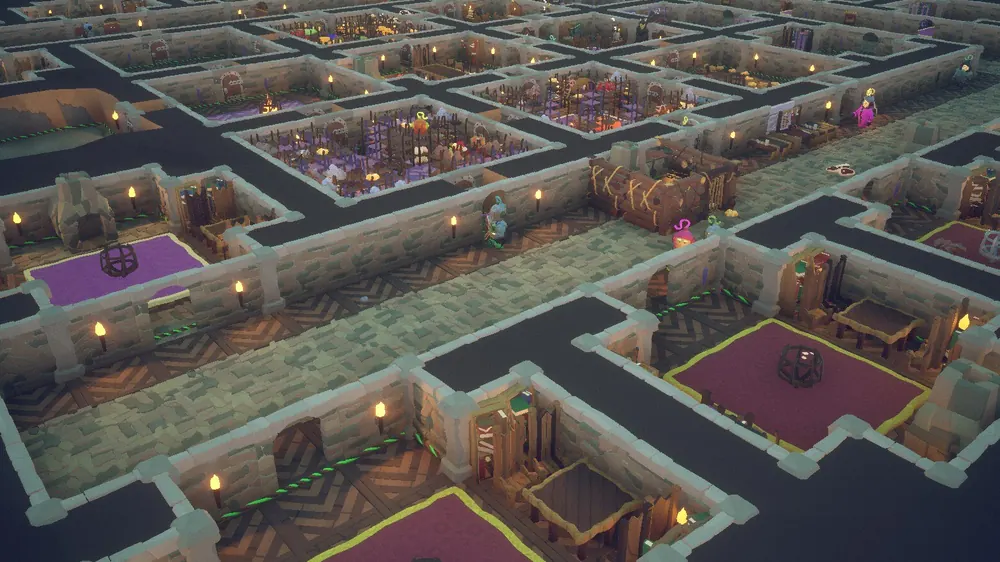
A room counts when it is enclosed by walls and a roof and contains the props its type needs. Build small, high-quality bedrooms, one shared dining hall, a kitchen-larder pair, a workshop, a study, a worship courtyard and at least one cell. Quality matters more than size for mood, prestige and Esteem.
Rooms are the unit of comfort in Noble Fates. Nobles do not just need a bed; they need a room that the game recognises as a bedroom, and they judge its quality.
What makes a room count
Three conditions:
- Enclosure. Walls on all sides, with a door for access.
- Roof. The area must be covered, except for deliberately outdoor spaces.
- Props. The room type needs the right props. A bedroom needs a bed; a dining room needs a table and seating.
A bed in a corridor is not a bedroom. A table in the open is not a dining room. If the room does not register, you get no mood or prestige benefit.
The core room list
| Room | Minimum props | Why you need it |
|---|---|---|
| Bedroom | Bed | Sleep and personal space |
| Dining hall | Table, chairs, light | Shared meals and social time |
| Kitchen | Cook fire or stove, prep surface | Cooking throughput |
| Larder | Shelves, door | Slowed food decay |
| Workshop | Relevant station | Crafting and production |
| Study | Research prop, light | Research speed |
| Worship courtyard | Altar, shrines (outdoor) | Faith and favor |
| Cell | Bed or restraint prop | Prisoners without a full prison |
| Storage | Shelves, crates | Organized hauling |
You do not need every room on day one. The order in the building guide→ is bedroom, kitchen, workshop, worship, walls.
Bedrooms: small and good beats big and bare
A bedroom's job is to give a noble a private, pleasant place to sleep.
Practical layout:
- Size: 3x3 minimum, 4x4 comfortable.
- Props: bed, a small shelf, a light, one decoration.
- Door: one, positioned so the bed is not in the walking line.
- Quality: improve the bed and shelf when a builder has spare time.
A 3x3 bedroom with improved props is better than a 6x6 room with a crude bed and nothing else. Quality drives prestige and mood.
The one-tile cell trick
In 1.0, a T0 bedroom of one tile can serve as a cell. That means you can hold prisoners from very early in the game without building a dedicated prison block.
Use it for:
- holding a captured raider for ransom,
- a temporary cell while you decide an enemy's fate,
- a cheap early labour pool.
Do not use it as permanent noble housing. It is a cell, not a bedroom.
Dining hall: the opinion engine
Shared meals are one of the cheapest mood and opinion tools in the game, and they only work if there is a room for them.
- Put the dining hall next to the kitchen so food travels a short distance.
- Size it for your whole court plus two seats, not for your current population.
- Light it properly. Dark dining rooms are miserable.
- Add decoration. This is the room guests see.
Schedule a shared meal block so the hall is actually used. The schedule guide→ has the template.
Kitchen and larder
These two rooms should be adjacent, and both should be enclosed.
Kitchen:
- Cook fire or stove.
- Prep surface.
- Storage for ingredients within arm's reach.
- One assigned cook, not a rotating crowd.
Larder:
- Shelves for stacking.
- A door that closes.
- Storage specializations set so raw food, meals and junk do not mix.
- Cool, dry placement, away from forges.
Food decay is a real cost. A well-built larder pays for itself in a season. See the food guide→.
Workshop
A workshop is a station plus walking space.
- Place the station against a wall.
- Leave a lane in front of it.
- Keep raw materials in a nearby stockpile, not in the workshop itself.
- Improve the station when you can; better stations work faster.
If your crafters spend half their day walking to materials, the workshop is in the wrong place.
Study
A study is a desk, a chair, light and quiet.
- Enclosed room, door, no through traffic.
- Good light, especially underground.
- Near the larder so the researcher eats without a long walk.
- Improve the desk for quality.
See the research guide→ for who should work here.
Worship courtyard
The exception to every roofing rule: it must be open to the sky.
- Walled courtyard, no roof.
- Altar in the centre.
- Shrines around it, improved for prestige.
- Idols along one wall, dedicated to one or two gods.
- Benches for social time.
Covered in detail in the worship guide→.
Room quality and Esteem
Every room contributes to the kingdom's comfort and prestige. Nobles compare their housing to their expectations.
If nobles are unhappy and the food is fine, check rooms:
- Are they actually enclosed and roofed?
- Do they contain the right props?
- Is the quality low?
- Is the noble's room far from their workplace?
A court of well-built small rooms produces loyalty. A court of big empty halls produces resentment.
Sources
Official source: Noble Fates on Steam ↗
- 1.0 patch notes ↗ for the T0 one-tile cell, room props and quality improvements.
- Steam store page ↗ for the kingdom-building framing.
- Steam Community guides ↗ for player room layouts.
FAQ
Why is my bedroom not registering?
It is probably not fully enclosed, not roofed, or missing a bed. Check for a one-tile gap in the walls.
Can a room be underground?
Yes. Underground rooms need lamps for light, and underground farms need water and light, but a bedroom, kitchen or workshop works fine below ground.
Does room size matter?
Quality matters more than size. A small room with good props beats a large bare room for mood and prestige.
Can I use one room for two purposes?
Sometimes, but it usually hurts quality. A bedroom that is also a storage room is a poor bedroom. The one-tile cell is the main deliberate exception.