
Noble Fates How to Have Children and Marry
How marriage and children work in Noble Fates: finding partners, wedding requirements, pregnancy, raising heirs and why marriage is your best recruitment.
Put a noble with a compatible partner in the same kingdom, let them build a relationship during free time, and hold a wedding. Children follow from married couples living in the same settlement. The hard part is not the wedding; it is having a bed, food and a room good enough that the couple stays happy.
Family is the engine of the dynasty systems. Marriage brings new nobles into your court, children produce heirs, and both feed the succession and Esteem systems.
Marriage: what you actually need
The game does not have a single "marry" button that works from anywhere. The path is social:
- Two unmarried nobles in the same kingdom. One can be a visitor you recruited or a noble from an allied kingdom who joins you.
- Positive opinions. They need to like each other, not just like you.
- Free time together. Couples form during social time. A schedule with no free time produces no relationships. See the schedule guide→.
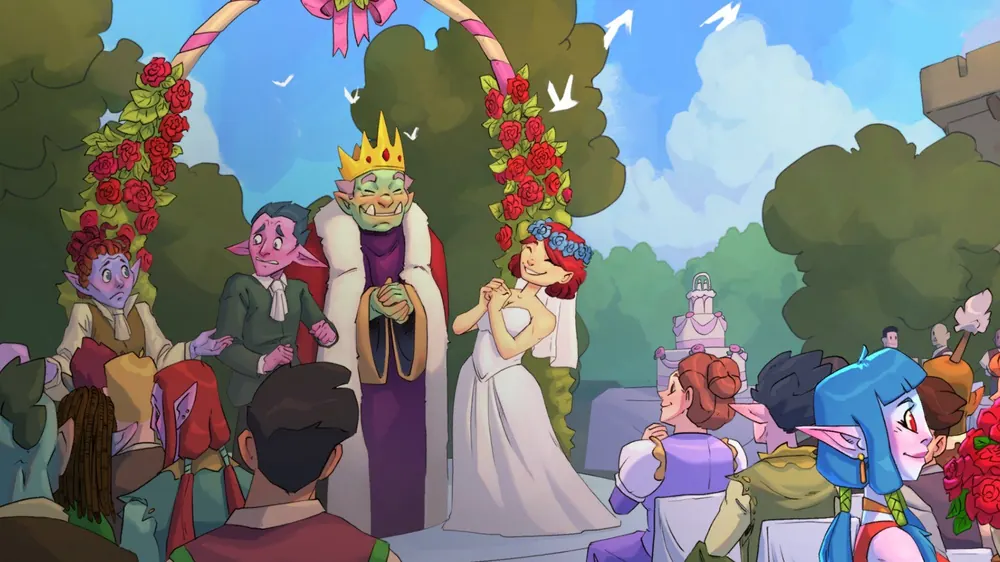
- A wedding. Once a relationship exists, the wedding is a ceremony you arrange. 1.0 added wedding visuals, and the ceremony is a social event that other nobles attend.
What raises the odds:
- Shared workspace and dining room, so they spend time near each other.
- A pleasant settlement: worship courtyard, decorated rooms, good food.
- Free time in the evening rather than scattered idle moments.
- Compatible sexuality and preferences, which are visible on the mortal's detail panel.
What kills it:
- Long work blocks with no social window.
- Separate housing across the map.
- A noble who is constantly miserable from Esteem, food or room quality.
Children: the practical requirements
Once a couple is married and living together, children arrive over time.
- Babies count toward kingdom size, so plan housing and food before a baby boom.
- Children grow up over years, inheriting traits, opinions and cultural leanings from their parents and the kingdom.
- A child of the ruler is the natural heir. The succession guide→ covers choosing one.
You cannot rush children. What you can do is make the kingdom a place where families thrive: enough beds, good food, a worship courtyard, and a schedule that leaves evenings free.
Marriage as recruitment
This is the part most players miss. A marriage adds a noble to your court with their own skills and traits.
| What you get | Why it matters |
|---|---|
| Their skills | A high-Reasoning spouse can anchor research for a decade |
| Their opinions | They arrive with a view of your kingdom, which you can shape |
| Their family ties | A link to another kingdom, useful for diplomacy |
| Children | The next generation of nobles and heirs |
Match for need, not for story. If your kingdom is starving, marry a farmer. If your research is stalled, marry a scholar. If your military is weak, marry into a martial family.
The more people guide→ covers the other recruitment routes.
Weddings and prestige
A wedding is a social event. Nobles who attend get opinion boosts, and the ceremony itself adds to the kingdom's story.
Practical advice:
- Hold the wedding somewhere nice, not in the stockpile.
- Make sure food and drink are available, because guests eat.
- Time it for a free-time block so nobody is dragged away from work.
- Use the event to repair a damaged relationship between two nobles who both attend.
Do not throw weddings during a food crisis or a raid. A hungry guest is not a grateful guest.
Family and Esteem
Children change your kingdom size tier, and size changes Esteem. A kingdom that grows from Small to Medium because of babies can suddenly have nobles complaining about a crowded court.
Mitigations:
- Keep housing quality ahead of population.
- Check Esteem after each birth.
- Use the kingdom size guide→ to plan tiers.
- If a noble hates large kingdoms, consider giving them a role that keeps them busy and valued, or accept that they will be unhappy.
Raising an heir
An heir is not just a child with a title. They need:
- Visibility: a job, a patrol, a diplomatic trip. Unknown heirs attract factions.
- Skills: let them train in something useful.
- Relationships: the court should know them before the ruler dies.
- A backup: at least two viable heirs, because war and plague happen.
Ruler death mutates opinions across the court. An heir with real relationships survives that moment; an heir who was kept in a nursery does not.
Common family mistakes
- No free time. No relationships, no marriages, no children.
- Marrying for stats only and ignoring opinion. A brilliant spouse who hates the court is a liability.
- Ignoring the size tier. Babies push you over a tier and Esteem drops.
- One heir. Always have two.
- Throwing a wedding during a crisis. It reads as a party while people starve.
Sources
Official source: Noble Fates on Steam ↗
- Steam store page ↗ for family, inheritance and relationships.
- Feature Breakdown III ↗ for the family and inheritance design.
- 1.0 patch notes ↗ for marriage visuals and ruler-death opinion changes.

FAQ
Why won't my nobles marry?
Usually no free time together, poor opinions, or incompatible preferences. Check the schedule and the couple's opinion of each other.
Do children count toward kingdom size?
Yes. Babies are counted, so family growth is also kingdom growth.
Can I marry a noble from another kingdom?
Yes, that is one of the main diplomatic uses of marriage. The spouse joins your court and brings skills and ties.
How long until a child becomes an adult?
Children grow over game years, not days. Plan succession on a multi-year horizon and keep a backup heir.