
Noble Fates Farming: Crops, Winter and Water
Noble Fates farming guide: crop dormancy, watering with pumps and outlets, tree farming from pine cones and acorns, and underground farms for winter.
Farm in plots near water, assign real farmers, and plan for dormancy: grass, cotton and Octoberberries stop growing in winter. Water a 9x9 area per pump-and-outlet pair, build an underground farm before your first hard winter, and farm trees from pine cones and acorns for renewable wood.
Farming in Noble Fates is less about planting and more about scheduling. The crops are simple; the seasons and the water are not.
What you can grow
The 1.0 notes name several crops and their quirks:
- Octoberberries - a berry crop, dormant in winter.
- Cotton - fibre crop, dormant in winter.
- Grass - dormant in winter, used for feed and grazing.
- Trees - evergreens grown from pine cones, oaks grown from acorns. Renewable wood is a mid-game unlock that changes everything.
Different crops have different seasons, water needs and processing chains. The general pattern:
| Crop type | Role | Winter behaviour |
|---|---|---|
| Fast vegetables | Early food | Often dormant |
| Berries | Food variety, mood | Octoberberries dormant |
| Cotton | Textiles | Dormant |
| Grass | Animal feed | Dormant |
| Trees | Wood, fuel | Evergreens tolerate cold better |
The practical lesson is that a single-crop farm is a seasonal gamble. Plant at least two things with different dormancy windows.
Water: pumps, outlets and the 9x9 rule
The 1.0 water rework made irrigation more predictable.
- A pump draws water from a source.
- An outlet delivers it to an area.
- One pump with one outlet waters roughly a 9x9 region.
- If you split one pump across several outlets, they divide the flow. More outlets means less water each.
Practical layouts:
- One pump, one outlet for a compact farm block. Simplest and most reliable.
- One pump, multiple outlets for a large field complex, accepting slower irrigation per field.
- Multiple pumps if you have the labour and the water source, each feeding its own block.
Do not build a farm far from water and assume hauling will cover it. Irrigation is a plumbing problem, not a labour problem.
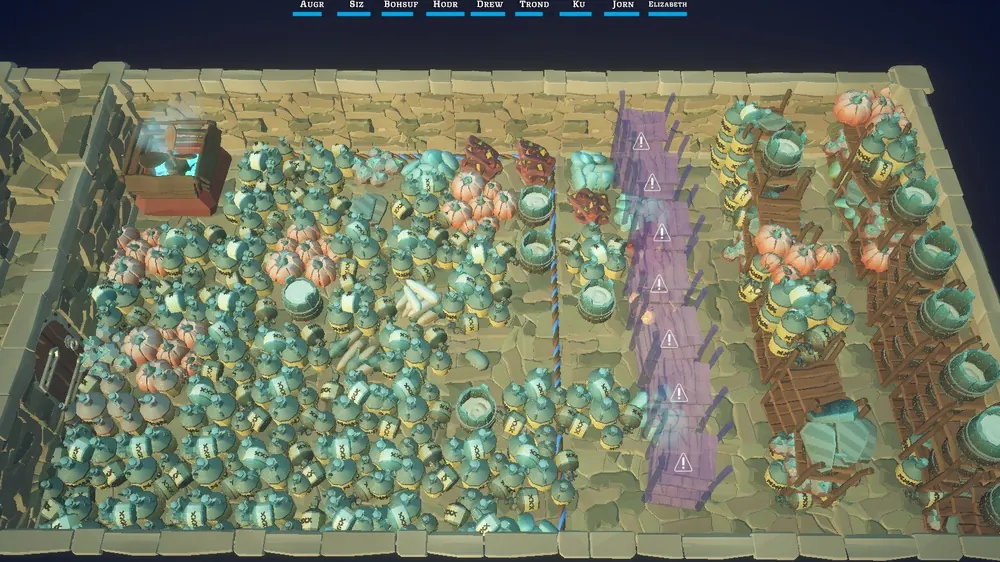
The farming workflow
- Clear and prepare the plot. Level ground near water, inside or near your walls.
- Build irrigation. Pump at the water, outlet at the field.
- Plant. Select the crop for the season.
- Assign farmers. Farming as a top-priority job for at least one noble.
- Harvest on time. A crop left in the field rots or wastes labour.
- Store indoors. Straight into the larder, not a pile outside.
Farmers need to be able to reach every tile. A field with props scattered across it, or a fence with one gate, wastes walking time.
Winter: the real test
Grass, cotton and Octoberberries go dormant. That means:
- Animal feed runs short, so your pastures need stored feed.
- Textile production stops, so craft cloth in autumn.
- Berry food stops, so your larder must carry the court.
Three winter strategies:
1. Store aggressively in autumn
Harvest, cook, preserve and store. A full larder in late autumn is worth more than a bigger field.
2. Build an underground farm
Underground farms keep growing through winter, which makes them the strongest long-term answer.
Requirements:
- Light: lamps or windows. Without light, crops do not thrive.
- Water: a pump and outlet inside the underground space.
- Space: enough room for real plots, not a token 3x3.
Start the dig in autumn, not in the middle of winter.
3. Farm trees
Evergreens from pine cones and oaks from acorns give you renewable wood and fuel. Tree farming is slow to start and pays for decades. Put it on marginal land you were not going to farm anyway.
Underground farms in detail
An underground farm solves three problems at once: winter, raids and surface space.
Layout that works:
- Carve a chamber with a ceiling height that allows props.
- Run a pump from an underground water source, or bring water down.
- Place outlets to cover your plot area, remembering the 9x9 rule.
- Install lamps across the whole growing area.
- Keep the farm near the larder so harvests move quickly.
Underground farms are also safer. Raiders dig and bash, but they prefer the gate house, and a farm behind two doors is not the first thing they reach.
Farming and animals
Farms feed animals, and animals feed nobles. The loop is:
- Grass and crops feed livestock.
- Livestock provide milk, meat, wool and eggs.
- Manure and grazing keep pasture land productive.
If you run pastures without a feed plan, your animals starve in winter and your food supply collapses in spring. The animal breeding guide→ covers feed and pasture management.
Farming mistakes to avoid
- One crop. Dormancy takes it all at once.
- Farm far from water. Irrigation beats hauling.
- No assigned farmer. Crops are planted and never harvested.
- Storage outside. A harvest that rots is not a harvest.
- No tree farm. Wood becomes the mid-game bottleneck.
- Ignoring winter. Autumn surplus is not a winter plan.
Sources
Official source: Noble Fates on Steam ↗
- 1.0 patch notes ↗ for crop dormancy, tree farming, underground farms and the water rework.
- Steam store page ↗ for the kingdom-building framing.
- Steam Workshop ↗ for farming mods such as KFarming.
FAQ
Why did my crops stop growing?
Winter dormancy. Grass, cotton and Octoberberries stop growing in the cold season. Underground farms avoid this.
How much area does one pump water?
One pump with one outlet covers roughly a 9x9 area. Splitting the pump across outlets divides the flow.
Can I farm underground?
Yes, with light and water. Underground farms are the best winter solution and they are safer from raids.
How do I get renewable wood?
Farm trees: evergreens from pine cones, oaks from acorns. It is slow to start and very strong long term.